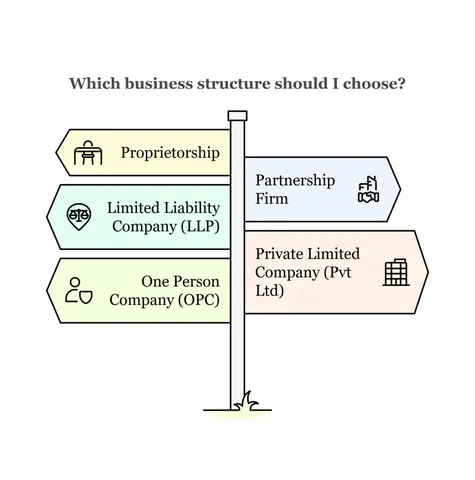
Comparison Between OPC and LLP: Advantage of One Person Company

The introduction of the One Person Company (OPC) and Limited Liability Partnership in India has transformed the means of conducting business in India and provides limited liability for members of both structures. The differences between the structures exist in the way they are incorporated and organised, and tax benefits provided. This article will provide comparison information between an OPC and an LLP, highlighting the advantages of each.
Points of Difference Between OPC and LLP
| Point of Difference | One Person Company (OPC) | Limited Liability Partnership (LLP) |
|---|---|---|
| Applicability | Incorporated under the Companies Act 2013 | Incorporated under the Limited Liability Partnership Act 2008 |
| Registering Authority | Registrar of Companies (ROC) | Registrar of LLP |
| Number of Members | Only 1 member is required | Minimum 2 members, no maximum limit |
| Minimum Capital | No minimum capital required after 2015 amendment | No specific minimum paid-up capital |
| Compliances | Higher statutory compliance cost | Lower statutory compliance cost |
| Penalty on Non-Compliance | Up to 1 Lakh | Up to 5 Lakh |
| Audit Requirements | Mandatory audit | Audit required only when turnover exceeds Rs 40 Lakhs or capital contribution exceeds Rs 25 Lakhs |
| Conversion | Can be converted to Private Limited Company after 2 years | No conversion option available |
| Taxation Benefit | Wealth tax applies, and there is no uniformity in Minimum Alternate Tax | No wealth tax, uniform Minimum Alternate Tax rates |
| Inheritance of Entity | Requires a nominee for succession | Perpetual succession, independent of partners |
Both LLPs and OPCs provide businesses with limited liability protection, though OPCs are typically the better structure for sole proprietors who hope to retain complete control over the entity. On the other hand, Limited Liability Partnerships (LLPs) are usually the best structure option for two or more partners to establish a business together. Regardless of which form a business takes, Limited Liability Companies (LLCs) and Limited Partnership entities will protect each of the owners' /members' personal property from being seized for debts owed by the company.
Advantages of One Person Company (OPC)
The One Person Company (OPC) is a modern form of a private limited company that allows an individual entrepreneur to run their business while enjoying the benefits of limited liability. With the amendment in 2015, OPCs can now be incorporated without a minimum capital requirement, making it more accessible for small business owners and startups.
An OPC (one-person company) is another type of private limited company, in this case an individual entrepreneur running their company, receiving the benefit of limited liability for a sole proprietor. Since the 2015 addition of OPC to the list of Private Limited Companies, the minimum capital requirement does not limit small-business owners from incorporating as an OPC. With OPC as the only entity providing the sole member with total control of the entity, it is no longer necessary to have a second partner or director; thus, an OPC has the advantage of being a separate legal entity (registered with the Company Act of 2013) that provides the member with both credibility and legal recognition.
An OPC enables individual entrepreneurs to enjoy all of the benefits of the company structure without putting together a team of partners or directors.
Conclusion
In conclusion, both OPC and LLP are great business structures, but each has its own unique advantages depending on the business needs. OPC is perfect for solo entrepreneurs looking for limited liability protection, while LLP is better for businesses that require flexibility and multiple partners.